Project
Group academic project
Stack
Adobe After Effects
Microsoft Word
Scientific and institutional sources
Scope
E-learning design
Scientific communication
Language
French
Duration
4 months
Year
2026
Project overview
Context
This group project involved designing a micro-learning module on planetary health. We chose to focus on heatwaves in Paris and the urban heat island effect. The module connects urban design, human health and sustainable adaptation solutions.
Objectives
Explain the causes of urban heat islands
Show how extreme heat affects human health and urban systems
Present sustainable solutions for adapting cities and housing.
Process description
Tools Used
Microsoft Word was used to define the specifications, learning structure and storyboard, and to organise the content before production.
Adobe After Effects was used during the initial motion-design phase to prepare visual assets and test the audiovisual direction of the project. Scientific articles and institutional reports were also used as source material to build the learning content and support the key messages presented in the module.
Methodology
We first analysed scientific and institutional sources on urban heat and its health impacts. From this research, we defined the target audience, prerequisites, learning objectives and the level of detail required for the module.
The content was then divided into short learning sequences covering the causes of urban heat, its effects on health, possible adaptation strategies and learner assessment. We also worked on the order of the information, the duration of each sequence and the balance between explanatory content, visuals and interactive elements.
The storyboard was used to translate this structure into a more concrete learning experience before any audiovisual production began.
Work Organisation
The project was completed by a three-person team, with tasks divided between research, learning design, content development, visual preparation and storyboard production.
I created a WhatsApp group to make coordination easier and keep the project moving between classes. We also met in person to work together on the storyboard and interface mockup.
The project scope later changed, and the final video was removed from the required submission. The final work therefore focused on instructional design, the e-learning structure and audiovisual pre-production.
My Role
E-Learning Designer
I defined the target audience, prerequisites, learning objectives, format, module structure and estimated duration. I also worked on the overall learning progression and the organisation of the content into short learning units.
Project Coordination
I helped divide the tasks within the team, coordinate the different parts of the project and keep the work moving forward between classes and group meetings.
Content & Visual Research
I co-wrote part of the e-learning design dossier and researched images and visual assets to support the planned video and keep the visual direction consistent with the module.
Final deliverables
E-Learning Dossier & Assessment Scenario · Storyboard & Motion Design Assets
A complete specification defining the audience, prerequisites, learning objectives, format and structure of a twelve-to-fifteen-minute module.
E-Learning Design Dossier
A learning journey covering urban heat islands, health impacts and sustainable adaptation. The assessment was designed as an interactive crisis scenario in which learners select the most appropriate solutions during a heatwave.

E-Learning Dossier Cover
Storyboard & Motion Design Preparation
A storyboard including the visual concept, voice-over script, subtitles, animation ideas and selected visual and audio assets. Initial sequences were prepared in After Effects before the final video was removed from the required submission.

Storyboard cover
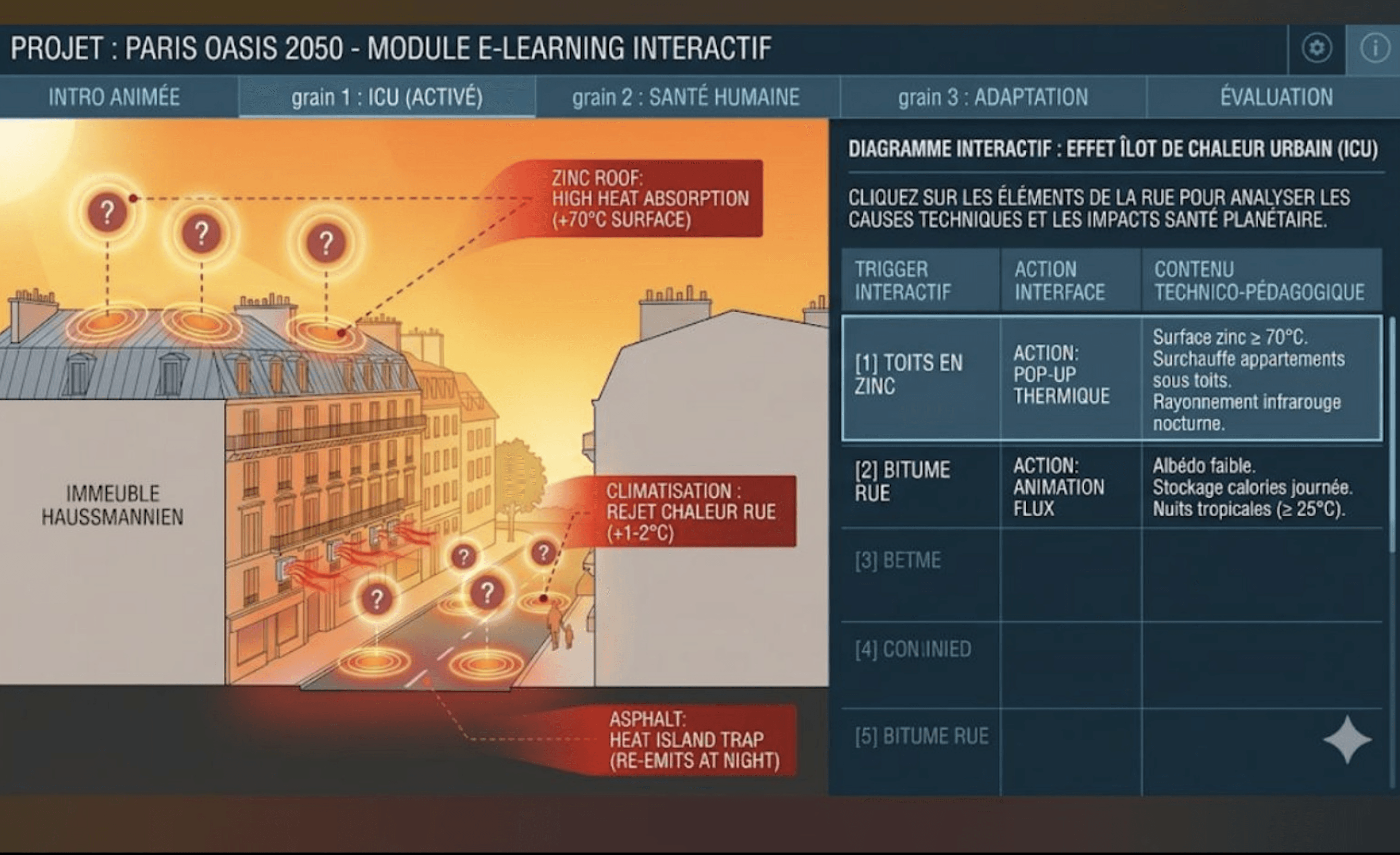
Below is the interactive concept mockup for the first learning unit on the urban heat island effect:
Here some assets from the After Effects project workspace:


Critical reflections - Réflexion critique
Acquis
Ce projet m’a appris à construire un module en partant du public et des objectifs pédagogiques, plutôt que du contenu disponible. Il fallait d’abord se demander ce que l’utilisateur devait comprendre et retenir, puis organiser le contenu autour de cette progression.
J’ai aussi appris à découper un sujet scientifique dense en séquences courtes et progressives, adaptées à des personnes ne disposant d’aucun prérequis scientifique. Cela m’a obligée à simplifier sans trop appauvrir le contenu, et à réfléchir à l’ordre dans lequel présenter les informations.
Le travail sur le storyboard et le mockup m’a également permis de mieux comprendre le passage entre un contenu pédagogique écrit et une expérience plus visuelle et interactive.
Difficultés rencontrées
Le cadrage du projet a évolué au cours du semestre. Nous avons d’abord dû recentrer le sujet afin de renforcer son lien avec la santé planétaire, ce qui a demandé de reprendre une partie des recherches et de réorganiser le contenu.
La vidéo prévue au départ a ensuite été retirée du rendu final alors que nous avions déjà commencé à préparer le storyboard, les visuels et certains éléments dans After Effects.
Il a donc fallu adapter le projet sans repartir de zéro, et conserver une cohérence entre les recherches, la structure pédagogique, le mockup et les éléments de préproduction déjà créés.
Choix méthodologiques
Nous avons choisi une progression simple :
Comprendre le phénomène
Identifier ses effets
Découvrir les solutions
Mettre les connaissances en pratique.
Le module a été conçu pour des adultes vivant à Paris, sans connaissances scientifiques particulières. L’évaluation repose sur une situation concrète afin d’éviter un simple quiz de mémorisation.
Compétences mobilisées
Conception pédagogique
J’ai défini le public cible, les prérequis, les objectifs pédagogiques, le format et la durée du module.
Architecture et structuration des contenus
J’ai participé à l’organisation du parcours en grains pédagogiques courts, avec une progression allant de la compréhension du phénomène aux solutions d’adaptation.
Recherche et vulgarisation scientifique
Les informations issues de publications scientifiques et de ressources institutionnelles ont été sélectionnées et simplifiées pour un public non spécialiste.
Scénarisation pédagogique
Le contenu a été pensé comme un parcours associant explications, éléments visuels, interactions et mise en situation.
Storyboarding et préproduction audiovisuelle
Le storyboard a permis d’anticiper les visuels, les animations, la voix off, les sous-titres et le rythme de la vidéo avant sa réalisation.
Travail collaboratif
Le projet a nécessité une répartition des responsabilités et une mise en cohérence des recherches, des contenus pédagogiques et des propositions visuelles.
Pistes d’amélioration
Je pousserais d’abord le mockup plus loin en réalisant plusieurs écrans du module, et pas seulement le premier grain sur l’îlot de chaleur urbain. Cela permettrait de mieux montrer la navigation entre les différentes séquences et l’évolution du parcours pédagogique.
Je développerais aussi davantage le scénario d’évaluation, avec plusieurs situations et des retours différents selon les choix de l’utilisateur. Le principe était déjà prévu dans le dossier, mais il pourrait être beaucoup plus concret et interactif.
Enfin, j’aurais aimé aller jusqu’à la création de la vidéo à partir du storyboard et des éléments préparés pour After Effects. On aurait pu tester réellement le rythme, la voix-off, les sous-titres et l’articulation entre texte, image et animation.