

Project
Academic group project
Stack
Google Suite
Adobe Suite
Heretto (DITA)
HTML/CSS
Scope
Technical Writing
UX Writing
Structured Content
Web Development
Localisation
Language
French
English
Duration
3 months
Year
2026
Project overview
Context
The objective was to create clear and consistent documentation for the Renault Megane E-Tech Electric across several formats and for different audiences.
The project combined technical documentation, digital support content and promotional communication in French and English.
Objectives
Make technical information accessible
Adapt content to each format and audience
Maintain editorial and terminological consistency.
Process description
Tools Used
Heretto was used to structure technical content according to DITA principles. Google Drive and Google Docs supported collaborative writing and file sharing, while Google Sheets was used to manage the project schedule, deadlines and task progress. WhatsApp and Zoom were also used to coordinate the team and monitor work throughout the project.
Methodology
We began by reviewing Renault’s official documentation to identify the information that was both technically reliable and relevant to our project. From there, we selected and reorganised the content according to the purpose of each deliverable: a maintenance guide, a support website and a marketing flyer.
The same source material therefore had to be adapted in different ways depending on the audience and format. For the guide, the priority was accuracy and clarity; for the website, accessibility and user guidance; and for the flyer, concision and impact. This required us to move constantly between technical information, content structure and user needs.
Work Organisation
The project was organised around several working groups, each responsible for a specific deliverable. We met regularly, either in person or via Zoom, to review progress, discuss difficulties and coordinate the different parts of the project. At key stages, the whole team also met together so that each group could report on its progress and make sure the different deliverables remained consistent.
Each team leader was responsible for monitoring the work of their group and reporting back to the Head of Project. As the person responsible for the website and UX writing, I created a dedicated WhatsApp group for the members working on the website. I used it to coordinate tasks, answer questions, clarify priorities and keep track of everyone’s progress throughout the project.
To support this organisation, the Head of Project created a detailed project schedule in Google Sheets. Key milestones and deadlines were defined in advance, which helped us anticipate dependencies between tasks, avoid last-minute work and deliver the project on time.
My Role
Technical Writer · Maintenance Guide
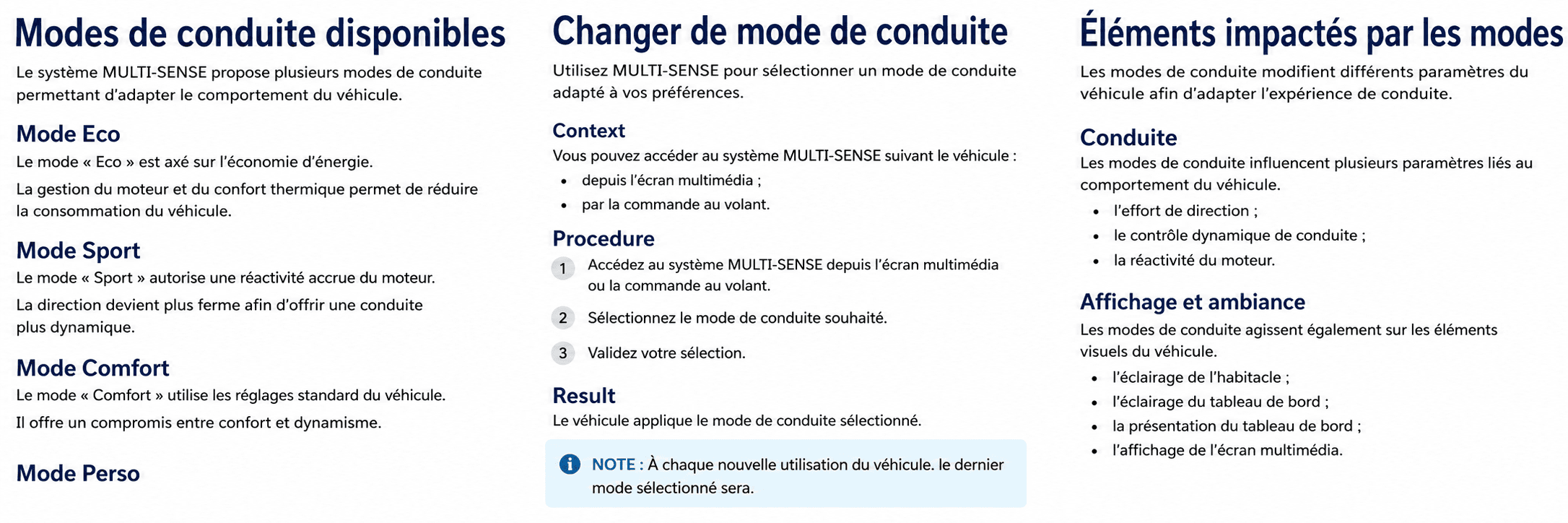
For the maintenance guide, I was responsible for writing the Driving Modes section, focusing on Renault’s MULTI-SENSE system and its main settings. I first reviewed the available technical information, then selected what was most useful for the user.
I reorganised the content so that the different driving modes, their effects and the procedure for changing modes could be understood quickly. My aim was to keep the information technically accurate while making it more direct, structured and easy to consult.
UX Writer & Content Manager · Website
For the website, I worked both as a UX Writer and as the person responsible for coordinating the website team. I helped define the structure of the content and adapted technical information into shorter, more user-oriented sections suited to an online support experience.
I also worked on the wording of headings, navigation elements and support content so that users could quickly understand where to find the information they needed. Alongside the writing itself, I coordinated the members working on the website, monitored the progress of tasks and made sure the different pages remained consistent in terms of content and structure.
Content Manager · Flyer
For the marketing flyer, my role was to select the most relevant product information and adapt it to a much shorter and more promotional format.
Unlike the maintenance guide, the goal was not to provide detailed technical explanations, but to highlight key information quickly and clearly. I therefore focused on prioritising the main messages, simplifying the wording and ensuring that the content could be understood at a glance while remaining consistent with the information used elsewhere in the project.
Final deliverables
Website preview · Flyer . Maintenance guide
Support Website
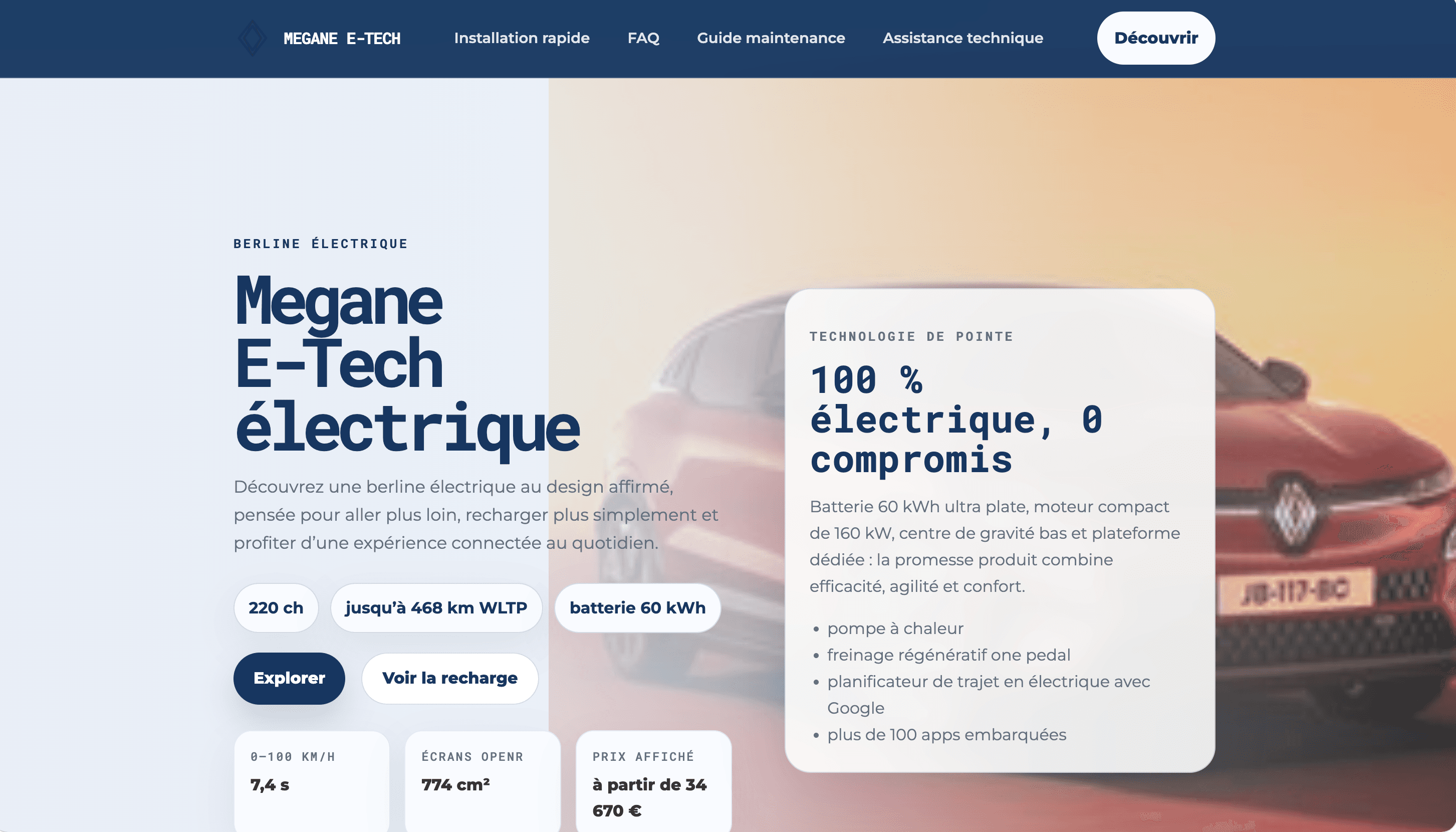
User-centred content providing installation guidance, FAQs, technical support and downloadable documentation (website not online yet).
Below is a preview of every page of the website:

Promotional Flyer
A concise presentation of the vehicle’s main features and user benefits:

Maintenance Guide
Bilingual technical documentation covering vehicle use, safety, charging, digital features and troubleshooting. Made for non-specialist user.
Below is the section I wrote - Modes de conduite:
Critical reflections - Réflexion critique
Acquis
Ce projet m’a appris à adapter une même information à différents publics, supports et niveaux de lecture.
La rédaction de la partie Modes de conduite m’a permis de sélectionner, hiérarchiser et simplifier des informations techniques tout en préservant leur exactitude. Le site et le flyer demandaient une approche plus concise et davantage orientée vers les besoins de l’utilisateur.
Difficultés rencontrées
La principale difficulté a été de garder une vraie cohérence entre tous les contenus produits par le groupe. Nous avons travaillé sur plusieurs supports à la fois : le guide, le site web et le flyer, avec des objectifs assez différents. Il fallait donc éviter de répéter les mêmes informations partout, mais aussi faire attention à ne pas les présenter de manière contradictoire.
De mon côté, j’ai surtout dû trouver le bon équilibre entre précision technique et simplicité, notamment pour le site et pour la partie du guide dont j’avais la charge.
Choix méthodologiques
Nous sommes partis de la documentation officielle Renault pour récupérer des informations fiables, puis nous les avons triées en fonction du support et du public visé. L’idée n’était pas de reprendre exactement les mêmes contenus partout.
Pour le guide, j’ai gardé une structure plus détaillée et progressive afin que l’utilisateur puisse comprendre les différents modes de conduite et savoir comment les utiliser.
Pour le site, j’ai davantage simplifié et raccourci les contenus, avec une logique plus orientée navigation et recherche rapide d’information.
Pour le flyer, j’ai retenu uniquement les éléments les plus importants, avec un ton plus direct et plus promotionnel.
Compétences mobilisées
Rédaction technique et structurée
Sélection, hiérarchisation et simplification de contenus techniques.
Gestion documentaire
Organisation cohérente de l’information entre plusieurs supports.
Localisation et communication plurilingue
Production et adaptation de contenus en français et en anglais.
Gestion de contenu numérique
Structuration de contenus destinés à un site web.
Gestion de projet collaborative
Répartition des rôles, utilisation d’outils partagés et coordination des contributions.
Pistes d’amélioration
Avec du recul, nous aurions pu mieux cadrer les contenus dès le début du projet. Par exemple, avant de commencer à rédiger, nous aurions pu décider ensemble quels termes employer pour parler des mêmes fonctionnalités, quelles informations devaient apparaître dans chaque support et jusqu’où entrer dans le détail. Cela aurait évité certaines hésitations au moment de rédiger et facilité l’harmonisation entre le guide, le site et le flyer.
Nous aurions aussi pu prévoir une relecture finale entre les différents membres du groupe. Chacun aurait pu relire un livrable sur lequel il n’avait pas directement travaillé, afin de repérer plus facilement les différences de formulation, les répétitions ou les incohérences entre les supports.